All published articles of this journal are available on ScienceDirect.

Effectiveness of the Basic Infection Control Skills License (BICSL) Training Program on Nurses' Knowledge, Attitudes, and Practices in Makkah, Saudi Arabia

Abstract
Introduction
Healthcare-associated infections (HCAIs) remain a major global health concern. In Saudi Arabia, the Basic Infection Control Skills License (BICSL) program was introduced to standardize infection prevention and control (IPC) training among healthcare workers. However, evidence on its effectiveness among nurses remains limited.
Methods
A multicenter, quasi-experimental, one-group pre-post study was conducted among 360 nurses from 5 public hospitals in Makkah, Saudi Arabia, during the 2024 BICSL implementation cycle. All participants received the same 3-day, in-person BICSL intervention; no random allocation or concurrent comparison group was used. A validated self-administered questionnaire assessed knowledge, attitude, and self-reported practice before and immediately after training. Paired t-tests, Wilcoxon signed-rank tests, effect sizes, reliability analyses, baseline-adjusted models, change-score models, and sensitivity analyses were conducted.
Results
Knowledge scores increased from 8.54 ± 2.03 to 10.71 ± 1.79, attitude scores from 2.30 ± 0.77 to 2.70 ± 0.51, and practice scores from 4.48 ± 1.91 to 5.90 ± 1.85 (all p < 0.001). Wilcoxon tests confirmed the pre-post differences. Cohen's dz values were 0.72 for knowledge, 0.43 for attitude, and 0.55 for practice. In adjusted analyses, improvement in knowledge remained significantly associated with post-training practice and practice improvement.
Discussion
The findings suggest that structured BICSL training may strengthen nurses' IPC-related knowledge and self-reported practice. However, interpretation should remain cautious because the one-group pre-post design cannot exclude testing effects, seasonal influences, concurrent IPC activities, or social desirability bias.
Conclusion
BICSL training was associated with improved knowledge, attitudes, and practices (KAP) scores among nurses in hospitals in Makkah. Future evaluations should include control groups, longer follow-up, observational audits, and IPC outcome indicators.
1. INTRODUCTION
Healthcare-associated infections (HCAIs) are a major cause of morbidity, mortality, and increased healthcare costs worldwide. HCAI burden varies across regions and remains a continuing challenge in both high-income and emerging healthcare systems [1, 2]. In Saudi Arabia, hospital infections remain a recognized public health issue, and previous studies have reported gaps in knowledge of hand hygiene and adherence to infection control among healthcare workers [3-6].
Standard precautions are central to infection prevention and control (IPC). They include hand hygiene, appropriate use of personal protective equipment (PPE), sharps safety, environmental cleaning, injection safety, waste disposal, and precautions for transmission-based risks [7-9]. Nurses are frontline healthcare workers and are therefore central to IPC implementation in routine clinical care [10, 11].
The Kingdom of Saudi Arabia has implemented several strategies to strengthen IPC, including the Basic Infection Control Skills License (BICSL) program. BICSL was established to provide standardized training in essential IPC competencies across healthcare settings [12]. Although several Saudi studies have examined IPC knowledge, attitudes, and practices (KAP) among healthcare workers [13-17], limited evidence exists on whether BICSL training itself is associated with measurable changes in nurses' KAP.
This study evaluated changes in nurses' knowledge, attitudes, and self-reported practices regarding standard precautions after BICSL training in Makkah, Saudi Arabia. The study was guided by the KAP framework, recognizing that knowledge may shape attitudes and that both may influence practice, while also acknowledging that practice change is affected by organizational and contextual factors such as workload, resources, and institutional IPC culture [6, 11, 18, 19].
1.1. RESEARCH QUESTIONS
The following research questions guided this study; no formal directional hypotheses were prespecified:
- To what extent do nurses' knowledge, attitudes, and self-reported practices regarding standard precautions change after completing the BICSL training program?
- Are the observed pre-post changes in knowledge, attitude, and practice scores statistically significant when assessed using both parametric and non-parametric methods?
- Which demographic, professional, and institutional factors are associated with post-training practice scores and improvement in practice after adjusting for baseline practice?
- How should the observed improvements be interpreted considering the quasi-experimental one-group pre-post design and the absence of a control group?
2. MATERIALS AND METHODS
2.1. Research Design and Study Setting
This multicenter, quasi-experimental, one-group pre-post study was conducted in 5 Ministry of Health public hospitals in Makkah, Saudi Arabia: Al Noor Specialist Hospital, Hira General Hospital, King Abdulaziz Hospital, King Faisal Hospital, and Maternity and Children Hospital. The study was implemented during the 2024 Hajj-related BICSL training period, when hospitals in Makkah experienced increased patient flow and heightened IPC preparedness requirements. All participants received the same intervention; there was no random allocation or concurrent comparison group. The study is reported in accordance with the TREND guideline for nonrandomized evaluations.
Because the study did not include randomization or a concurrent control group, the design assessed within-participant changes after training rather than establishing definitive causal effects. Potential threats to causal inference, including testing effects, maturation, secular trends, and concurrent IPC initiatives, were considered when interpreting the findings.
2.2. Target Population, Sampling, and Participants
The target population comprised registered nurses employed in the 5 participating hospitals who had not completed BICSL training during the current implementation cycle. Healthcare workers other than nurses, nurses who did not consent, and nurses without paired pre- and post-training data were ineligible for the paired analysis. The sampling frame included approximately 3,500 nurses in Makkah, and systematic random sampling was applied to the nursing staff lists, selecting approximately every 10th nurse. The minimum required sample size was 347; the calculation parameters were not available in the study documentation.
The study records documented 360 nurses who completed the pre-training questionnaire, the three-day BICSL training, and the immediate post-training questionnaire and who were included in the final paired analysis. The numbers initially approached or assessed for eligibility, excluded or declining before enrollment, and lost during follow-up were not separately documented. Protocol deviations were also not separately documented (Fig. 1).
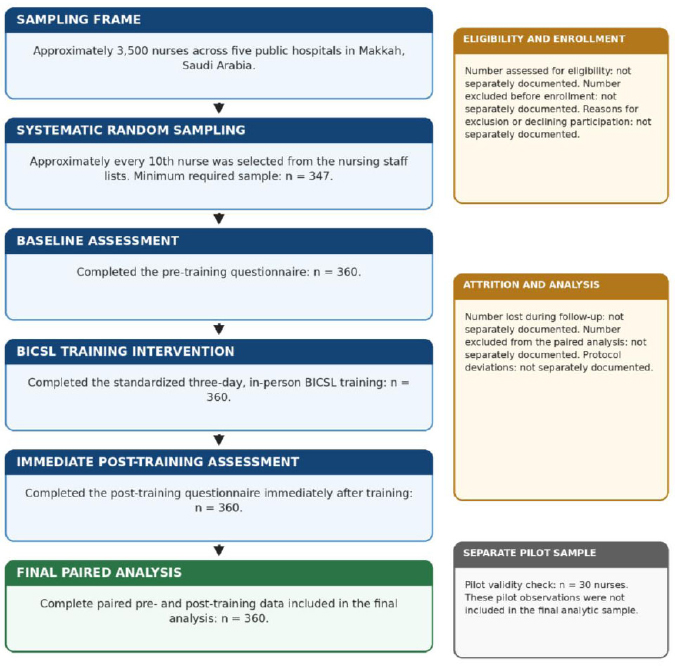
Participant flow through recruitment, BICSL training, and paired analysis.
2.3. BICSL Training Intervention
The BICSL intervention was delivered in person over 3 consecutive days by certified BICSL trainers from the participating hospitals' infection control departments. The standardized curriculum covered 7 core components: hand hygiene, personal protective equipment, biological spill management, needle-stick injury management, transmission-based precautions, respirator fit testing, and powered air-purifying respirators. Each module combined theoretical instruction, trainer demonstration, and participant return demonstration. Training was delivered in Arabic and English as needed. Because all participants received the educational intervention, neither participants nor trainers were blinded. Although the curriculum and procedures were standardized across hospitals, formal independent fidelity auditing of individual sessions was not conducted. Session group size was not recorded, and no incentives or other adherence-promoting activities were documented.
2.4. Data Collection and Measurement Instrument
Data were collected using a self-administered structured questionnaire adapted from previously used KAP instruments and aligned with CDC and WHO IPC guidance [6, 20, 21]. The questionnaire captured demographic and professional characteristics and assessed 3 co-primary outcome domains: knowledge, attitude, and practice. A pilot validity check was conducted with 30 nurses before the main study; these pilot observations were not included in the final analytic sample.
The knowledge scale included 13 dichotomous items scored 1 for a correct response and 0 for an incorrect or “do not know” response, giving a score range of 0-13. The attitude scale included three dichotomous items, scored 1 for a positive/correct response and 0 otherwise, giving a score range of 0-3. The practice scale included 9 self-reported items. For the primary analysis, “always” was coded as 1 to represent strict adherence, while “often,” “sometimes,” “seldom,” and “never” were coded as 0, yielding a score range of 0-9. This dichotomization was selected to identify consistent IPC compliance, but it also reduces ordinal information, which is noted as a limitation.
The pre-test was administered before BICSL training. The post-test was administered immediately after completion of the 3-day training within the same implementation cycle.
2.5. Statistical Analysis
Descriptive statistics summarized participant characteristics and KAP scores. The individual nurse was the unit of analysis. Paired t-tests were used to compare pre- and post-training KAP scores. Because the domain scores were based on dichotomous items and might not be normally distributed, Wilcoxon signed-rank tests were also reported. Domain-level effect sizes were calculated using Cohen's dz, and ceiling effects were assessed by reporting the proportion of participants who achieved the maximum score. No missing values were imputed; analyses were restricted to complete paired records. Data were analyzed using IBM SPSS Statistics version 31.0.2.0.
Internal consistency was assessed separately for each KAP subscale at pre-test and post-test using KR-20/ Cronbach's alpha and average inter-item correlations. Because the attitude scale contained only 3 items and all domains used dichotomous scoring, reliability estimates were interpreted cautiously.
To address concerns about post-test-only regression, the revised analysis used baseline-adjusted and change-score models. The baseline-adjusted model estimated the post-training practice score, adjusting for baseline practice, changes in knowledge and attitude, gender, nationality, qualification, department group, and hospital fixed effects. The change-score model estimated change in practice score and included baseline practice, knowledge, and attitude, changes in knowledge and attitude, and the same covariates. HC3 robust standard errors were used. Continuous predictors were mean-centered before creating interaction terms. A binomial GLM sensitivity analysis modeled the number of compliant practice items out of 9. Variance inflation factors (VIFs) were examined; age was evaluated but not retained in the final hospital fixed-effect models because diagnostics indicated instability when age and hospital indicators were included together. Baseline practice was retained in all adjusted models. Holm-Bonferroni correction was applied to exploratory pairwise subgroup comparisons.
2.6. Ethics
The study was approved by the Jawatankuasa Etika Penyelidikan Manusia Universiti Sains Malaysia (JEPeM-USM; protocol code USM/JEPeM/PP/23020204) and by the General Directorate of Research & Studies, Ministry of Health, Kingdom of Saudi Arabia (decision approval number 1122-836 076-K-02-H). Data were anonymized before analysis.
3. RESULTS
3.1. Participant Characteristics
Participant flow is presented in Fig. (1). A total of 360 nurses with complete paired pre- and post-training data were included. The mean age was 39.93 ± 11.00 years (range 22-59 years). Most participants were male (55.00%), Saudi (53.06%), staff nurses (42.78%), and employed in ICU departments (74.17%). Participant characteristics are presented in Table 1.
| Characteristic | Category | n | % or Value |
|---|---|---|---|
| Age, years | Mean ± SD (range) | - | 39.93 ± 11.00 (22-59) |
| Hospital | Hira General Hospital | 87 | 24.17 |
| Hospital | Maternity and Children Hospital | 76 | 21.11 |
| Hospital | King Faisal Hospital | 74 | 20.56 |
| Hospital | Al Noor Specialist Hospital | 63 | 17.50 |
| Hospital | King Abdulaziz Hospital | 60 | 16.67 |
| Gender | Male | 198 | 55.00 |
| Gender | Female | 162 | 45.00 |
| Nationality | Saudi | 191 | 53.06 |
| Nationality | Non-Saudi | 169 | 46.94 |
| Qualification | Staff Nurse | 154 | 42.78 |
| Qualification | Senior Nurse | 110 | 30.56 |
| Qualification | Registered Nurse | 96 | 26.67 |
| Department group | ICU | 267 | 74.17 |
| Department group | Others | 93 | 25.83 |
3.2. Pre- and Post-Training Kap Changes
KAP scores increased significantly across all domains after BICSL training (Table 2). Knowledge increased from 8.54 ± 2.03 to 10.71 ± 1.79, attitude from 2.30 ± 0.77 to 2.70 ± 0.51, and practice from 4.48 ± 1.91 to 5.90 ± 1.85. Paired t-tests and Wilcoxon signed-rank tests were statistically significant for all domains (p < 0.001). Cohen's dz indicated a moderate-to-large effect for knowledge (0.72), a small-to-moderate effect for attitude (0.43), and a moderate effect for practice (0.55). Ceiling effects were most evident for attitude, for which 72.5% of participants achieved the maximum post-training score.
| Domain | Max Score |
Pre-training Mean ± SD |
Post-training Mean ± SD |
Mean Difference | 95% CI | t(df = 359) |
t-test p-value |
Wilcoxon p-value |
Cohen's dz |
Pre at Maximum n (%) |
Post at Maximum n (%) |
|---|---|---|---|---|---|---|---|---|---|---|---|
| Knowledge | 13 | 8.54 ± 2.03 | 10.71 ± 1.79 | 2.17 | 1.86, 2.48 | 13.68 | <0.001 | <0.001 | 0.72 | 8 (2.2) | 62 (17.2) |
| Attitude | 3 | 2.30 ± 0.77 | 2.70 ± 0.51 | 0.40 | 0.30, 0.50 | 8.24 | <0.001 | <0.001 | 0.43 | 169 (46.9) | 261 (72.5) |
| Practice | 9 | 4.48 ± 1.91 | 5.90 ± 1.85 | 1.41 | 1.15, 1.68 | 10.45 | <0.001 | <0.001 | 0.55 | 2 (0.6) | 38 (10.6) |
3.3. Reliability of KAP Subscales
Internal consistency was low, especially for the three-item attitude domain (Table 3). Accordingly, the KAP domain totals should be interpreted as pragmatic summary scores of heterogeneous IPC competencies rather than as highly internally consistent psychometric scales.
| Domain | Time Point | No. Items | Score Range | Mean ± SD | KR-20 / alpha | Avg Inter-item Correlation |
|---|---|---|---|---|---|---|
| Knowledge | Pre | 13 | 0-13 | 8.54 ± 2.03 | 0.323 | 0.036 |
| Knowledge | Post | 13 | 0-13 | 10.71 ± 1.79 | 0.441 | 0.057 |
| Attitude | Pre | 3 | 0-3 | 2.30 ± 0.77 | 0.143 | 0.052 |
| Attitude | Post | 3 | 0-3 | 2.70 ± 0.51 | -0.051 | -0.017 |
| Practice | Pre | 9 | 0-9 | 4.48 ± 1.91 | 0.434 | 0.079 |
| Practice | Post | 9 | 0-9 | 5.90 ± 1.85 | 0.458 | 0.086 |
3.4. Baseline-adjusted and Change-score Models
In the baseline-adjusted model (Table 4), change in knowledge was significantly associated with a higher post-training practice score (beta = 0.105, p = 0.001). In contrast, change in attitude was positive but not statistically significant (beta = 0.150, p = 0.154). Staff nurses had lower adjusted post-training practice scores than senior nurses (beta = -1.552, p < 0.001). ICU nurses had higher adjusted practice scores than nurses in other departments (beta = 0.583, p = 0.007). The model R2 was 0.251, and the adjusted R2 was 0.225.
| Variable | Beta | Robust SE | 95% CI | p-value |
|---|---|---|---|---|
| Intercept | 6.69 | 0.407 | 5.89, 7.49 | <0.001 |
| Male vs. Female | 0.074 | 0.179 | -0.28, 0.42 | 0.680 |
| Saudi vs. Non-Saudi | -0.106 | 0.175 | -0.45, 0.24 | 0.543 |
| Staff Nurse vs. Senior Nurse | -1.552 | 0.218 | -1.98, -1.13 | <0.001 |
| Registered Nurse vs. Senior Nurse | -0.463 | 0.243 | -0.94, 0.01 | 0.057 |
| ICU vs. Others | 0.583 | 0.214 | 0.16, 1.00 | 0.007 |
| Al Noor Specialist vs. Hira General | -1.245 | 0.309 | -1.85, -0.64 | <0.001 |
| King Abdulaziz vs. Hira General | -0.724 | 0.284 | -1.28, -0.17 | 0.011 |
| King Faisal vs. Hira General | -0.689 | 0.252 | -1.18, -0.19 | 0.006 |
| Maternity & Children vs. Hira General | -0.607 | 0.249 | -1.10, -0.12 | 0.015 |
| Baseline practice score | -0.022 | 0.05 | -0.12, 0.08 | 0.651 |
| Change in knowledge score | 0.105 | 0.032 | 0.04, 0.17 | 0.001 |
| Change in attitude score | 0.15 | 0.105 | -0.06, 0.36 | 0.154 |
The model used OLS with HC3 robust standard errors and hospital fixed effects. Reference groups were female, non-Saudi, senior nurse, non-ICU/other departments, and Hira General Hospital.
In the change-score model (Table 5), improvement in knowledge was significantly associated with improvement in practice (beta = 0.181, p < 0.001). Improvement in attitude was positive but not statistically significant (beta = 0.280, p = 0.114). Lower baseline practice was strongly associated with greater practice improvement (beta = -1.018, p < 0.001), consistent with greater room for improvement among participants with lower initial scores. The model R2 was 0.615 and adjusted R2 was 0.599.
| Variable | Beta | Robust SE | 95% CI | p-value |
|---|---|---|---|---|
| Intercept | 4.831 | 1.029 | 2.81, 6.85 | <0.001 |
| Male vs. Female | 0.074 | 0.179 | -0.28, 0.43 | 0.681 |
| Saudi vs. Non-Saudi | -0.116 | 0.174 | -0.46, 0.23 | 0.506 |
| Staff Nurse vs. Senior Nurse | -1.511 | 0.217 | -1.94, -1.09 | <0.001 |
| Registered Nurse vs. Senior Nurse | -0.45 | 0.241 | -0.92, 0.02 | 0.062 |
| ICU vs. Others | 0.545 | 0.216 | 0.12, 0.97 | 0.012 |
| Al Noor Specialist vs. Hira General | -1.081 | 0.329 | -1.73, -0.44 | 0.001 |
| King Abdulaziz vs. Hira General | -0.615 | 0.286 | -1.17, -0.05 | 0.032 |
| King Faisal vs. Hira General | -0.607 | 0.256 | -1.11, -0.11 | 0.018 |
| Maternity & Children vs. Hira General | -0.551 | 0.253 | -1.05, -0.05 | 0.030 |
| Baseline practice score | -1.018 | 0.05 | -1.12, -0.92 | <0.001 |
| Baseline knowledge score | 0.136 | 0.069 | 0.00, 0.27 | 0.048 |
| Baseline attitude score | 0.175 | 0.219 | -0.25, 0.60 | 0.425 |
| Change in knowledge score | 0.181 | 0.052 | 0.08, 0.28 | <0.001 |
| Change in attitude score | 0.28 | 0.177 | -0.07, 0.63 | 0.114 |
3.5. Sensitivity and Multiple-comparison Analyses
The binomial GLM sensitivity analysis treated practice as the number of compliant “always” responses out of 9 (Table 6). Results were consistent with the OLS models: improvement in knowledge remained significantly associated with compliant practice responses (OR = 1.055, p < 0.001), whereas change in attitude was not statistically significant after adjustment (OR = 1.081, p = 0.139).
| Variable | Odds Ratio | 95% CI Lower | 95% CI Upper | p-value |
|---|---|---|---|---|
| Intercept | 2.978 | 1.978 | 4.484 | <0.001 |
| Male vs. Female | 1.04 | 0.872 | 1.24 | 0.660 |
| Saudi vs. Non-Saudi | 0.94 | 0.791 | 1.118 | 0.486 |
| Staff Nurse vs. Senior Nurse | 0.453 | 0.362 | 0.566 | <0.001 |
| Registered Nurse vs. Senior Nurse | 0.771 | 0.595 | 1 | 0.050 |
| ICU vs. Others | 1.349 | 1.1 | 1.655 | 0.004 |
| Al Noor Specialist vs. Hira General | 0.525 | 0.388 | 0.711 | <0.001 |
| King Abdulaziz vs. Hira General | 0.671 | 0.502 | 0.898 | 0.007 |
| King Faisal vs. Hira General | 0.687 | 0.527 | 0.895 | 0.005 |
| Maternity & Children vs. Hira General | 0.712 | 0.547 | 0.927 | 0.012 |
| Baseline practice score | 0.991 | 0.944 | 1.041 | 0.727 |
| Change in knowledge score | 1.055 | 1.023 | 1.089 | <0.001 |
| Change in attitude score | 1.081 | 0.975 | 1.199 | 0.139 |
After Holm-Bonferroni correction, most exploratory subgroup differences were no longer statistically significant. For change-score subgroup comparisons, only the difference in attitude change between senior nurses and staff nurses remained statistically significant after correction (mean difference = -0.353, Holm-adjusted p = 0.041). Therefore, all subgroup findings are interpreted as exploratory (Table 7).
Table 7.
| Analysis set | Number of Pairwise Tests per KAP Domain | Findings Remaining Significant after Holm Correction |
|---|---|---|
| Change-score subgroup comparisons | 16 per domain | Only attitude change differed significantly between senior nurses and staff nurses; mean difference = -0.353, Holm-adjusted p = 0.041. |
| Baseline subgroup comparisons | 16 per domain | Baseline attitudes differed between senior nurses and staff nurses; baseline practices differed between senior nurses and staff nurses, and between staff nurses and registered nurses. |
4. DISCUSSION
This study found statistically significant improvements in nurses' knowledge, attitudes, and self-reported practices after completion of the BICSL training program. The magnitude of improvement was greatest for knowledge, followed by practice and attitude. The findings are consistent with the KAP framework and recent IPC literature, which suggest that knowledge acquisition, skills reinforcement, and supportive clinical environments can contribute to better IPC practice [11, 18, 19].
The improvement in knowledge is consistent with previous IPC training studies showing that structured educational interventions can improve nurses' understanding of standard precautions, hand hygiene, personal protective equipment, and sharps safety [10, 19, 22-24]. In the present study, BICSL combined theoretical instruction with demonstration and return-demonstration. This practical structure may explain why gains in knowledge were accompanied by measurable improvements in self-reported practice. The moderate baseline knowledge score also allowed room for observable post-training improvement.
Attitude improved significantly, but the standardized effect size was smaller than those observed for knowledge and practice. This may be explained by a ceiling effect, because many participants already had favorable attitudes before training and the post-training attitude score approached the maximum possible value. This finding differs from studies in which lower baseline attitude scores allowed larger post-training gains. In this context, BICSL may be more effective at reinforcing existing positive attitudes and translating them into practice than at producing large, measurable shifts in attitude scores.
Practice scores improved after training, consistent with previous studies reporting better IPC compliance following educational interventions [11, 22-24]. However, this finding must be interpreted cautiously because practice was self-reported and dichotomized using a strict definition, with only “always” coded as compliant. Differences between the present findings and studies based on direct observation may reflect social desirability bias, differences in clinical workload, and variation in institutional IPC monitoring systems [11].
The adjusted analyses suggest that improvement in knowledge was associated with higher post-training practice scores and greater improvement in practice. In contrast, improvement in attitude was positive but not statistically significant after adjustment. This may indicate that practice change after BICSL depends strongly on procedural knowledge and repeated competency demonstration, whereas favorable attitudes may be necessary but not sufficient for sustained behavioral change. Organizational conditions, such as workload, managerial support, availability of PPE, and other IPC resources, may influence whether favorable attitudes are translated into consistent practice [8, 18].
The higher adjusted practice scores among ICU nurses may reflect greater routine exposure to IPC procedures, higher perceived infection risk, and more frequent reinforcement of IPC policies in critical care settings. Conversely, differences by qualification and hospital site may reflect variation in staffing patterns, supervision, resource availability, local IPC culture, and opportunities for supervised practice [2, 11, 18, 25]. These findings indicate that BICSL effectiveness may depend not only on the training curriculum but also on the clinical and organizational environment in which nurses apply IPC practices.
5. LIMITATIONS
This study has several limitations. First, it used a quasi-experimental, one-group pre-post design without randomization or a concurrent control group. Therefore, although KAP scores improved after BICSL training, the changes cannot be attributed exclusively to the training program. Testing effects, repeated exposure to the questionnaire, maturation, secular trends, seasonal workload changes, Hajj-related preparedness activities, and concurrent institutional IPC initiatives may have contributed to the observed improvements.
Second, practice was measured using self-reported questionnaire items rather than direct observation or audit-based measures, which may have introduced social desirability bias. In addition, practice responses were dichotomized, with “always” coded as compliant and all other responses coded as non-compliant. Although this approach reflects strict adherence, it may have reduced measurement sensitivity by collapsing ordinal response information.
Third, the attitude scale contained only 3 items, and subscale reliability was low, particularly for the attitude domain. Therefore, the attitude findings should be interpreted cautiously. Future studies should use expanded and psychometrically validated KAP instruments with stronger construct validity.
Fourth, the study was conducted in 5 public hospitals in Makkah, and ICU nurses were overrepresented in the sample. Therefore, the findings may not be fully generalizable to non-ICU departments, primary healthcare centers, private hospitals, or other regions of Saudi Arabia.
Fifth, the post-training assessment was conducted within the same implementation cycle and measured short-term change. The study did not assess long-term retention of knowledge, attitudes, or practices. Future studies should include follow-up assessments at 3, 6, and 12 months.
Finally, this study did not include direct patient-safety or IPC outcome indicators, such as hand hygiene audit data, PPE compliance audits, needle-stick injury reports, or healthcare-associated infection rates. Training-related adverse events or unintended effects were not systematically collected. Future BICSL evaluations should triangulate self-reported KAP outcomes with observational audits and institutional IPC surveillance data.
CONCLUSION
Structured BICSL training was associated with improved knowledge, attitude, and self-reported practice scores among nurses in Makkah public hospitals. These findings support BICSL as a practical strategy for building IPC competencies, but the one-group design requires cautious interpretation. Future evaluations should include control groups, longer follow-up, observational audits, and IPC outcome indicators to confirm sustainability and patient-safety relevance.
AUTHORS' CONTRIBUTIONS
The authors' contributions were as follows: A.A.B. and N.M.M.M.: Study conception and design; A.A.B.: Data collection; A.A.B., N.M.M.M., and R.H.: Analysis and interpretation of results; A.A.B.: Initial manuscript preparation; and N.M.M.M. and R.H.: Critical revision of the manuscript. All authors reviewed the results and approved the final version of the manuscript.
LIST OF ABBREVIATIONS
| BICSL | = Basic Infection Control Skills License |
| CBAHI | = Saudi Central Board for Accreditation of Healthcare Institutions |
| CDC | = Centers for Disease Control and Prevention |
| HAI/HCAI | = Healthcare-Associated Infection |
| HCW | = Healthcare Worker |
| ICU | = Intensive Care Unit |
| IPC | = Infection Prevention and Control |
| KAP | = Knowledge, Attitude, and Practice |
| KSA | = Kingdom of Saudi Arabia |
| MOH | = Ministry of Health |
| NSI | = Needle-Stick Injury |
| PAPR | = Powered Air-Purifying Respirator |
| PPE | = Personal Protective Equipment |
| SP | = Standard Precautions |
| WHO | = World Health Organization |
ETHICS APPROVAL AND CONSENT TO PARTICIPATE
The study was approved by the Jawatankuasa Etika Penyelidikan Manusia Universiti Sains Malaysia (JEPeM-USM; protocol code USM/JEPeM/PP/23020204) and by the General Directorate of Research & Studies, Ministry of Health, Kingdom of Saudi Arabia (decision approval number 1122-836 076-K-02-H).
HUMAN AND ANIMAL RIGHTS
All human research procedures followed were in accordance with the ethical standards of the committee responsible for human experimentation (institutional and national), and with the Helsinki Declaration of 1975, as revised in 2013.
AVAILABILITY OF DATA AND MATERIALS
The data supporting the analysis are available from the authors upon reasonable request and upon approval from the Ministry of Health, Saudi Arabia.
ACKNOWLEDGEMENTS
The authors thank the participating hospitals, nursing departments, BICSL trainers, and all nurses who completed the questionnaires.