All published articles of this journal are available on ScienceDirect.

Mediating Role of Perceived Social Support in the Relationship between Stress and Resilience among Nursing Students in Saudi Arabia

Abstract
Introduction
The frameworks connecting social support, stress, and resilience remain poorly understood among nursing students in Saudi Arabia. This study investigated the mediating role of perceived social support in the relationship between perceived stress and psychological resilience.
Methods
A descriptive cross-sectional design was utilized with 190 nursing students at the University of Hail. Data were collected using three established instruments: the 10-item Perceived Stress Scale (PSS-10) to measure the construct of global stress; the 10-item Connor-Davidson Resilience Scale (CD-RISC-10) to measure the construct of psychological resilience; and the Multidimensional Scale of Perceived Social Support (MSPSS) to measure support constructs from family, friends, and significant others. Statistical analyses included Spearman rank-order correlation, One-Way ANOVA, and Path Analysis, with the Sobel test used to evaluate the mediation model.
Results
Perceived social support did not statistically significantly mediate the relationship between stress and resilience (p = 0.261). While a strong positive correlation was observed between stress and social support engagement, the year of study emerged as the primary predictor of resilience (eta = 0.520), representing a large effect size despite the statistical significance of other variables.
Discussion
The analysis indicates that the year of study was a primary predictor of resilience in this cohort, suggesting that professional maturity and clinical exposure may be more relevant than academic performance. Although a correlation was observed between stress and support engagement, perceived social support did not significantly mediate the relationship between stress and resilience, accounting for minimal variance. These results suggest a potential benefit in shifting toward “operational support” and structured clinical scaffolding to better assist students in navigating academic and clinical stressors.
Conclusion
Social support mechanisms among nursing students appear to function as reactive crisis-management tools rather than proactive buffers, often lacking the specific recovery pathways needed to translate perceived support into clinical resilience. Consequently, nursing education could benefit from a shift toward “operational” support, focusing on professional socialization and clinical competence, to address life-stage stressors and integrate resilience-building into high-stakes clinical practice.
1. INTRODUCTION
The specific stressors during training and clinical education have led to an increased focus on the mental health of nursing students. High amounts of academic stress negatively impact nursing students’ mental health and psychological resilience. For example, nursing students report high amounts of stress associated with clinical responsibilities and academic burnout, which contribute to anxiety [1, 2]. The ability to maintain psychological resilience positively protects nursing students’ mental health, reduces psychological stress, and supports overall adaptation during their educational journey [1, 3].
Numerous studies have examined the value of perceived social support as an intermediary factor on the continuum of stress and resilience. Research suggests that perceived social support, particularly in the form of emotional sustenance and motivation by family members and peers, is a factor that correlates with nursing students’ levels of resilience [4]. Furthermore, social support assists in overcoming stress, but, as maintained by a study [1], it also improves students’ adaptation and thriving capability in training environments. This is consistent with research that suggests perceived social support improves resilience, acting as a buffer against the adverse effects of stress [5]. Moreover, the relationship among stress, resilience, and social support is more prominent for nursing students in Saudi Arabia, whose support networks are shaped by cultural norms and community structures [2, 6]. Recent research highlights the psychological stress nursing students experience and emphasizes the need for adequate support [7].
Although there is considerable literature on this topic, the frameworks that connect social support, stress, and resilience remain poorly understood, specifically regarding nursing students in the context of Saudi Arabian healthcare education. Previous research has primarily targeted the general population or other categories of healthcare professionals, leaving nursing students in Saudi Arabia under-researched. In addition, the presence of culturally specific and, especially, family-centered support structures may profoundly influence this group’s stress and resilience interrelationships [6, 8]. Given the contextual expansion of nursing education and the growing demands and associated stressors of the healthcare workforce, the lack of focus is alarming [9].
This study aims to fill these gaps by focusing on the function of perceived social support in the relationship between stress and resilience in nursing students in Saudi Arabia; the implications of this work are considerable. The study was guided by five central hypotheses designed to explore the psychological landscape of nursing students. First, the study explored the impact of personal characteristics, hypothesizing that demographic factors, specifically year of study, grade-point average (GPA), and marital status, account for statistically significant differences in the levels of stress, resilience, and social support among participants (H1). Also, it was hypothesized that a significant relationship exists between perceived stress (PSS-10) and resilience (CD-RISC-10) (H2). Regarding the components of the mediation model, the study proposed that perceived stress is significantly associated with perceived social support (MSPSS) (H3) and that social support, in turn, is significantly associated with resilience when controlling for the effects of stress (H4). Building upon these associations, the hypothesis (H5) posited that perceived social support serves as a significant mediator in the relationship between perceived stress and resilience. These relationships, once understood, can be used to shape social support interventions that will strengthen the resilience and mental health of students. Educational institutions will be able to lessen the negative impact of stress on students and improve their mental health and academic output by implementing effective support strategies [10]. Hence, this study aims to examine the mediating role of perceived social support on the relationship between stress and resilience among nursing students.
2. METHODS
2.2. Setting
The study was undertaken at the Hail Region College of Nursing at the University of Hail (UoH) during the 2024 second semester. The university is the first public university established in Ha’il, Northern Saudi Arabia. It is a self-contained public university with its campuses dispersed throughout its outreach region. The University of Ha’il, College of Nursing, offers a full-time Bachelor of Science in Nursing (BSN) program. Theory instruction is housed on the main campus, with major affiliated hospitals and healthcare centers in the region serving as facilities for clinical assessments of students.
2.3. Participants and Sampling
The study population consisted of undergraduate nursing students at the University of Hail. Official enrollment and attrition data were obtained from the university registration office, which identified a total undergraduate population of approximately 1,220 students. The BSN program follows a five-year curriculum, comprising four years of theoretical and clinical coursework followed by a mandatory fifth-year internship. Because interns remain fully enrolled students until the completion of this final year, they were included in the sample alongside students in years 2, 3, and 4. This specific cohort was selected because they possessed both academic and clinical experience, providing a necessary bridge between theoretical knowledge and applied clinical data. To be eligible, students required full-time enrollment and active registration for the term. Conversely, students on academic, medical, or study leave, as well as part-time students, were excluded from the study.
Participants were invited to the study through official university communication channels, including student email accounts and the digital learning management system. The invitation included a description of the study’s purpose, an assurance of confidentiality, and a link to the informed consent form. This study used convenience sampling, as the study location was a single site. To achieve this, students who met the required academic level were selected for the sample. The sample size was determined in advance to ensure adequate statistical power. The total population for the study was 1,220, which allowed the sample size to be calculated based on a 95% confidence level and a 5% margin of error, ultimately requiring 169 participants. Also, to account for non-respondents or respondents who skipped survey questions, 200 students were invited; 190 completed the survey (a 95% response rate), exceeding the minimum required sample of 169. Consent was obtained from students, and the questionnaires distributed to them were used to achieve the required sample size for the study
2.4. Instrument
Data collection for this study utilized four primary components: a demographic profile and three established psychological scales. The initial section of the questionnaire collected essential participant demographic information, including age, sex, marital status (Married/Single/ Other), year of study (Second to Fifth Year/Interns), and GPA from the last semester, categorized into specific ranges (e.g., 4.0 - 3.5, 3.49 - 3.0, etc.).
The three primary instruments used to measure the psychological variables were the Multidimensional Scale of Perceived Social Support (MSPSS), the 10-item Connor-Davidson Resilience Scale (CD-RISC-10), and the 10-item Perceived Stress Scale (PSS-10). Perceived social support was measured using the MSPSS [11], a 12-item scale that assesses perceived support from family, friends, and a significant other. Participants responded on a 7-point Likert scale, ranging from 1 (Very Strongly Disagree) to 7 (Very Strongly Agree).
Resilience was assessed using the 10-item CD-RISC-10 [12]. This concise, unidimensional scale employed a 5-point rating (0 = Not true at all, 4 = True nearly all the time), with higher scores indicating greater resilience. Finally, the level of global perceived stress was evaluated using the PSS-10 [13]. The PSS-10 consists of 10 items rated on a 5-point scale from 0 (never) to 4 (very often), measuring the degree to which life situations are appraised as stressful, with positive items being appropriately reverse-scored to ensure higher scores reflect greater perceived stress.
The questionnaires underwent a validation process by four field experts (university professors and researchers/ psychometricians) who unanimously affirmed their content validity. A pilot study was conducted with 20 student nurses to assess the reliability of the measures. The reliability results for the MSPSS were 0.88, CD-RISC-10 was 0.91, and PSS-10 was 0.92 based on the 20 participants.
2.5. Data Collection Process
Data collection commenced only after receiving formal approval from the Ethics Review Board of the University of Hail. To minimize potential power imbalances or undue influence, recruitment was designed to be indirect and voluntary. While Department Heads served as principal collaborators for survey dissemination, their role was strictly administrative. They provided the Google Form link via automated university channels (email and the Learning Management System) rather than through personal solicitation.
To further protect participants, the process was designed to be entirely anonymous. Neither the researchers nor the Department Heads had access to identify which students chose to participate or decline. The invitation explicitly stated that participation was strictly voluntary and would have no impact on academic standing or grades. This ensures that students could complete the survey privately, following their scheduled classes, without any direct observation or pressure from faculty or administration. Data collection was conducted over a one-month period, from September 30 to October 30, 2025, providing students ample time to complete the survey.
2.6. Ethical Consideration
This protocol received approval from the Ethics Review Board of the University of Hail (H-2024-32). Confidentiality, privacy, and the rights of subjects to withdraw at any time without penalty were all addressed in the study. The study was designed and conducted in accordance with the ethical principles for medical research involving human subjects as set forth in the World Medical Association's Declaration of Helsinki.
2.7. Statistical Analysis
Descriptive statistics, including means, standard deviations, and frequencies, were calculated to summarize the sample's demographic characteristics and baseline levels of the primary variables: The PSS-10, CD-RISC-10, and MSPSS. Independent sample t-tests were used to assess mean differences across binary demographic groups (e.g., sex), while One-Way ANOVA was employed for groups with three or more categories (e.g., year level). Additionally, Spearman rank-order correlations were used to assess the strength and direction of relationships between all study variables. All inferential analyses were performed using total scores from the overall scale to ensure statistical accuracy. Lastly, path analysis was conducted to evaluate the hypothesized role of MSPSS as an intervening variable between stress and resilience. Statistical evaluation was conducted according to the criteria for mediation [14], with the indirect effect assessed via the Sobel test.
3. RESULTS
Table 1 presents sociodemographic characteristics of the participants. The mean age of the cohort was 25.4 years (SD = 4.4), with a higher proportion of female participants (57.9%) than male participants (42.1%). In terms of academic standing, the largest group was fourth-year students (31.6%), and nearly half of the sample (45.8%) maintained a GPA in the 3.5–4.0 range. The cohort exhibited a moderately high level of perceived social support (MSPSS) [ M = 60.5, SD = 16.4] and a high level of resilience, as measured by the CD-RISC-10 (M = 30.7, SD = 2.9). Perceived stress levels, measured via the PSS-10, were found to be within the moderate range (M = 22.2, SD = 2.3).
| Variable | Category | Frequency / Mean (M) | Percentage (%) / SD |
|---|---|---|---|
| Age | Mean (±SD) | 25.4 | ±4.4 |
| Sex | Female | 110 | 57.90% |
| Male | 80 | 42.10% | |
| Marital status | Single | 128 | 67.40% |
| Married | 62 | 32.60% | |
| Year of study | 2nd year | 46 | 24.20% |
| 3rd year | 52 | 27.40% | |
| 4th year | 60 | 31.60% | |
| 5th year (interns) | 32 | 16.80% | |
| GPA category | 4.0–3.5 | 87 | 45.80% |
| 3.49–3.0 | 58 | 30.50% | |
| 2.99–2.5 | 44 | 23.20% | |
| Social support (MSPSS) | Total score | 60.5 | 16.4 |
| Resilience (CD-RISC-10) | Total score | 30.7 | 2.9 |
| Perceived stress (PSS-10) | Total score | 22.2 | 2.3 |
Table 2 presents the levels of perceived social support, resilience, and stress along with participant demographics. The cohort exhibited a moderately high level of perceived social support (MSPSS) (M = 60.5, SD = 16.4) and a high level of resilience (M = 30.7, SD = 2.9). Perceived stress levels (PSS-10) were within the moderate range (M = 22.2, SD = 2.3). On the MSPSS, female and married participants reported significantly higher levels of support than their respective counterparts (t = -3.12, p = 0.002 and t = -4.89, p < 0.001, respectively). A gradual increase in support was observed across the years of study (F = 13.96, p < 0.001), with interns reporting higher scores than second-year students.
| Variable | Category | Social Support (MSPSS) Mean (SD) | Resilience (CD-RISC-10) Mean (SD) | Perceived Stress (PSS-10) Mean (SD) |
|---|---|---|---|---|
| Total Sample | Overall Mean | 60.5 (16.4) | 30.7 (2.9) | 22.2 (2.3) |
| Sex | Female (n=110) | 62.8 (15.2) | 29.8 (3.1) | 23.1 (2.1) |
| Male (n=80) | 57.3 (17.5) | 31.9 (2.6) | 21.0 (2.5) | |
| Marital status | Single (n=128) | 59.1 (16.8) | 30.5 (3.0) | 22.9 (2.2) |
| Married (n=62) | 64.2 (14.9) | 31.4 (2.7) | 20.1 (2.4) | |
| Year of study | 2nd year (n=46) | 58.5 (16.1) | 31.1 (2.8) | 21.5 (2.3) |
| 3rd year (n=52) | 60.2 (15.9) | 30.8 (3.0) | 22.1 (2.2) | |
| 4th year (n=60) | 61.4 (16.5) | 29.9 (3.1) | 23.4 (2.1) | |
| 5th year/intern (n=32) | 62.5 (16.2) | 30.2 (2.9) | 22.9 (2.4) | |
| GPA category | 4.0–3.5 (n=87) | 63.1 (15.5) | 32.2 (2.5) | 20.8 (2.5) |
| 3.49–3.0 (n=58) | 60.4 (16.3) | 30.5 (2.9) | 22.4 (2.2) | |
| 2.99–2.5 (n=44) | 55.6 (17.8) | 28.1 (3.2) | 24.5 (2.0) |
Concerning resilience, male participants scored significantly higher than female participants (t = -3.08, p = 0.002). While students in the highest GPA bracket exhibited higher descriptive resilience scores than those in the lowest bracket, this difference was not statistically significant (F = 2.01, p = 0.114). Regarding the PSS-10, fourth-year students and those with lower GPAs reported the highest stress levels, with significant associations confirmed for year of study (F = 4.51, p = 0.004) and GPA (F = 3.76, p = 0.011).
The results from the inferential analysis of demographic variables for the primary study constructs are provided in Table 3. Sex and marital status were shown to be statistically significantly related to stress levels (p = 0.003; p < 0.001, respectively). Although the sex variable was shown to be statistically significantly associated with stress, it was found to represent a small effect size in practical terms (rpb = 0.18). Thus, a statistically significant result does not always equate to a substantial real-world difference. The year of study (p = 0.004) and GPA (p = 0.011) also showed statistically significant associations with stress; however, these two variables also represented different levels of practical relevance, with effect sizes of 0.26 and 0.394, respectively. Concerning resilience, year of study was identified as the most influential predictor, with a statistically significant and large effect size (η = 0.52, p < 0.001). However, academic performance was shown not to have a statistically significant influence on resilience (p = 0.114), and although higher GPA earners had larger mean resilience scores, the association between academic performance and resilience was determined to be statistically weak (r = 0.34), which supports the notion that academic success is not an accurate indicator of resilience in this population.
| Dependent Variable | Independent Variable | Statistical Test | Value (t or F) | Effect Size (η or rpb) | p-value |
|---|---|---|---|---|---|
| Social support (MSPSS) | Sex | Independent t-test | t=−3.12 | 0.22 | 0.002** |
| Marital status | Independent t-test | t=−4.89 | 0.31 | <.001*** | |
| Year of study | One-way ANOVA | F=13.96 | 0.429 | <.001*** | |
| Resilience (CD-RISC-10) | Sex | Independent t-test | t=−3.08 | 0.19 | 0.002** |
| Year of study | One-way ANOVA | F=23.03 | 0.52 | <.001*** | |
| GPA category | One-way ANOVA | F=2.01 | 0.34 | 0.114 (NS) | |
| Perceived stress (PSS-10) | Sex | Independent t-test | t=−3.01 | 0.18 | 0.003** |
| Year of study | One-way ANOVA | F=4.51 | 0.26 | 0.004** | |
| GPA category | One-way ANOVA | F=3.76 | 0.394 | 0.011* |
Note: rpb = Point-Biserial Correlation; eta = Eta (Effect Size); NS = Not Significant. Significance levels: *p < .05, **p < .01, ***p < .001.
Table 4 and Figure 1 present the mediation analysis of perceived social support (MSPSS) on the relationship between perceived stress (PSS-10) and resilience (CD-RISC-10). The path analysis indicates that the criteria for mediation were not satisfied. Although the relationship between stress and perceived social support (Path a) was statistically significant (β = 3.016, p < 0.001), the relationship between social support and resilience (Path b) was not significant (β = 0.020, p = 0.258). Moreover, the total effect of stress on resilience (Path c) did not reach statistical significance (β = 0.029, p = 0.753).
| Path | Description | Coefficient (β) | SE | p-value | Significance |
|---|---|---|---|---|---|
| a | Stress → MSPSS | 3.016 | 0.374 | <0.001 | Significant |
| b | MSPSS → Resilience (Controlling for Stress) | 0.02 | 0.018 | 0.258 | Not significant |
| c' | Stress → Resilience (Direct Effect) | -0.032 | 0.106 | 0.762 | Not significant |
| c | Stress → Resilience (Total Effect) | 0.029 | 0.091 | 0.753 | Not significant |
| Final Model R2 (Resilience/ Stress + PSS): 0.007 | |||||
| Effect | Coefficient (a×b) | Sobel Test Statistic (z) | Sobel p-value | - | |
| Indirect Effect | 0.061 | 1.124 | 0.261 | Not significant | |
Note: Legend: β = Unstandardized Regression Coefficient; SE = Standard Error; p = Probability Value; R2 =Coefficient of Determination; z = Z-score for Sobel Test.
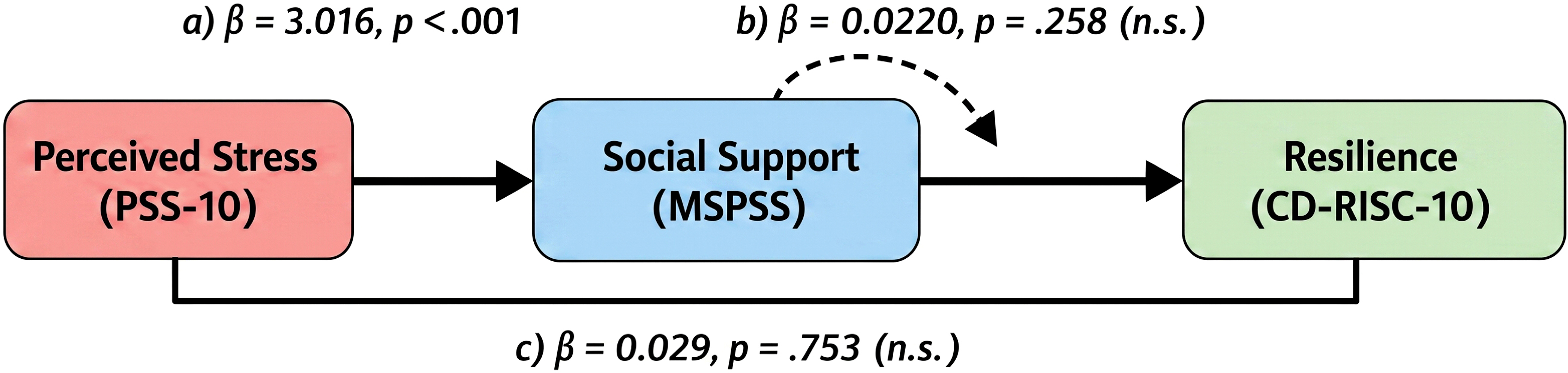
Path analysis of perceived stress, social support, and resilience.
Legend: Path a: Stress to Social Support.
Path b: Social Support to Resilience (Non-Significant).
Path c: Direct Effect of Stress on Resilience (Non-Significant).
Consistent with these findings, the Sobel test indicated that the indirect effect was not statistically significant (z = 1.124, p = 0.261). The R2 value of 0.007 suggests that the combined variables of stress and MSPSS account for less than 1% of the variance in resilience scores within this cohort. Therefore, the results do not support the hypothesis that MSPSS mediates the relationship between stress and resilience.
4. DISCUSSION
4.1. Perceived Social Support, Resilience, Stress, and Differences between Demographics
The cohort demonstrated a moderately high level of perceived social support on the MSPSS. This result is generally consistent with many other studies that have used the MSPSS to measure social support across a variety of populations. For example, one study reported an average MSPSS score in a group of older adults in Greece, which is very close to the average score in the present study [15]. Therefore, moderately high social support appears to be a stable and common experience across diverse populations when measured with this instrument. Additionally, researchers assessing medical students in Nigeria reported average item scores, indicating high levels of social support similar to the present findings [15]. The MSPSS has been shown to be a valid and reliable method of assessing perceived social support from family, friends, and significant others, providing a strong rationale for its use in this context [15, 16]. These levels may be indicative of the supportive nature of medical school, where students often complete difficult academic tasks together and form close peer relationships [17]. It has been shown that peer support is a key contributor to the psychological well-being and academic self-concept of medical students, and that a lack of such support can synergistically increase the likelihood of negative academic self-perception [17].
The present study found statistically significantly higher perceived social support levels in female participants than in male participants. This finding is consistent with a large body of research showing gender differences in support. For instance, female inmates were found to report statistically significantly higher levels of social support than male inmates on the MSPSS total score and all three subscales [18]. Similar patterns have been observed in samples of Korean adolescents [19]. However, there is some variability in the literature. One study of Lebanese adults did not find any statistically significant gender differences across any MSPSS dimensions, suggesting that discrepancies may be due to differing societal and cultural expectations regarding gender roles [ 20]. Other research found that while scores were largely equivalent between men and women among survivors of intimate partner violence, men reported statistically significantly greater levels of familial support [21]. The present study's statistically significant (though potentially small) gender difference appears consistent with the specific culture of the medical student population studied.
Statistically significantly higher perceived social support levels were reported by married participants than by unmarried participants. Previous studies support the idea that marital or partnered status is a strong predictor of perceived social support [22]. Furthermore, research has shown that single women report lower global support scores on the MSPSS than women who are romantically involved, which closely mirrors the current results [22]. This is likely due to a spouse or partner being the primary source of emotional support.
There was a statistically significant positive correlation between the level of perceived social support and the year of study. This may be because as students progress, they form more extensive professional and social networks of peers and mentors. Peer social support is a key predictor of academic success and mental health in this population; students with low levels of support are more likely to report academic difficulties [17]. Because the MSPSS can identify students at risk of mental health problems and guide interventions, monitoring these levels over time is highly useful for educational and clinical support [15]. While the present study found a statistically significant correlation, it is worth noting that year of study is only one of many factors contributing to a student's social network quality.
In this current study, participants reported high levels of resilience. Male participants reported statistically significantly higher levels of resilience than female participants. This is consistent with the literature, which suggests that social support and resilience are interdependent constructs [16]. It is possible that males in this study relied more on internal resilience, whereas females relied more on social connections to cope with challenges. Resilience also shows protective effects against stress; lower levels of parental resilience have been associated with higher levels of moderate-to-severe stress [23]. While students in the highest GPA group reported higher levels of descriptive resilience, this difference was not statistically significant. This may be due to the homogeneity of resilience levels in the cohort.
Participants reported moderate levels of perceived stress on the PSS-10. Fourth-year students and those with lower GPAs reported the highest levels of stress, with statistically significant correlations found for both years of study and GPA. This relationship between GPA and stress suggests a reciprocal link between academic performance and well-being [18]. Supportive friends and family have been found to be protective against moderate to severe stress [24]. The moderate stress levels found here, despite high social support, suggest that support mitigates some, but not all, of the stressors inherent in medical education.
The relationships observed are consistent with a theoretical framework, suggesting that social support and resilience are protective against psychological stress [15]. Even in high-stress environments like medical school, high levels of social support and resilience can exist concurrently. The statistically significant differences observed, with females reporting higher social support, males reporting higher resilience, and fourth-year students reporting higher stress, indicate that interventions designed to promote psychological well-being must take into account the unique needs of each demographic subgroup.
4.2. Mediation Analysis of Perceived Social Support on the Relationship between Perceived Stress and Resilience
The aim of this study was to determine if perceived social support acts as a mediator between stress and resilience. The path analysis and Sobel test yielded non-significant results in this study. This finding is further underscored by the final model R2 of 0.007, indicating that the combination of perceived stress and social support accounts for less than 1% of the total variance in resilience scores. This finding posits that, despite stress, individuals may experience a sense of social support while recognizing that this may not positively influence their resilience, particularly in fraught situations such as schooling or clinical work. The buffering hypothesis suggests that social support acts as a barrier, protecting individuals and fostering resilience against the negative effects of stress. However, research has shown that social support and stress are related in more complex ways. Some research studies state that the role of social support in stress management is significant, and that social support is more effective when it is provided to a greater rather than a lesser extent [25, 26]. This result stands in opposition to previous studies that viewed the relation of social support to resilience as being more direct and quantitative [27].
Numerous studies emphasize that social support and social connections must be of high quality rather than simply being available. Earlier findings stressed that, for psychological adjustment, an individual needs support derived from quality social interactions [28]. Furthermore, the lack of perception regarding quality social support despite the presence of strong support networks when examining emergency service workers with post-traumatic stress [29]. Research on specific groups, such as cancer patients or emergency service workers, has produced varying results when examining social support and resilience. Researchers have shown that perceived social support does not always lead to increased resilience [30, 31]. Conversely, it was noted that the presence of social support and its impact on resilience among people with substance use disorders [32] highlight the diversity of impact across different demographic categories. Moreover, the value of social support may erode, particularly in high-stakes clinical settings, in the presence of excessive stressors.
Scholars have demonstrated that, although stress levels remain high, caregivers may have social support that does not alleviate their mental health problems [31, 33]. This aligns with the results of the current study, which suggest that during stressful times, merely feeling that social support is available does not necessarily increase resilience. The Sobel test results, which were not significant, suggest that social support is not a simple “bridge” that enhances resilience when stress is high. Instead, it indicates that the MSPSS may have limitations in measuring the complexity of social support in stressful situations. Earlier research suggests that the complexities of personal relationships, the details of social interaction, and the qualitative value of support may require the use of additional, more sophisticated instruments [32]. This study illustrates the need for further work to understand the interplay among social support, stress, and resilience, especially regarding the specifics of the context and high-pressure situations. There are a number of possibilities that may help define the qualitative aspects of support, as well as the interactions between certain coping mechanisms and particular demographic groups, which may further explain the relationships between these key components in the field of psychology.
4.3. Study Implications
The findings of the current study indicate that nursing education needs to move away from a broad “open-door” support policy toward a more specific, operational support model. Given that perceived social support does not seem to play a mediating role in the relationship between stress and resilience, it implies that a student needs more than the feeling of support to recover from clinical or academic trauma. Thus, nursing programs should focus on the provision of clinical support, in the form of direct clinical teaching and structured peer debriefing, rather than general social support. These clinical and educational support strategies may be more beneficial if they are proactive rather than merely responsive; that is, they should be designed to counteract the “support-stress paradox” in which students seek support only when they are already stressed and overwhelmed.
The pivotal place of the “Year of Study” emphasizes that resilience in nursing is experiential rather than a static attribute. This suggests that the nursing curriculum could be restructured to include incremental clinical exposure, with more robust scaffolding for first- and second-year students to mitigate the “attrition of resilience” before they reach high-stakes clinical internships. Furthermore, the specific stressors for married and older students indicate that support must go beyond a “one-size-fits-all” model. To promote professional socialization and optimize academic productivity, the complexities of stress and adult role theory suggest that enhanced stress-resilience training, focusing on self-compassion and clinical self-efficacy, is needed.
4.4. Study Limitations
The primary limitations of this study are rooted in its design. A longitudinal study would be designed to address the temporal causation addressed by this study, but a cross-sectional design does not allow for that. Convenience sampling in only one site of the University of Hail also means the findings are not generalizable to other university cohorts. The sole use of self-report data (MSPSS, CD-RISC-10, PSS-10) means these findings are likely subject to response bias, too. Future research should account for objective data such as physiological measures or GPAs. Use of the Sobel test for mediation also reflects the standard of work in this research. More sophisticated methods exist, such as nonparametric bootstrap methods, which are standard for most work in the field of social science research. These limitations, combined with the likely exclusion of other relevant cohorts of the student population, dilute the findings and their wider relevance.
CONCLUSION
The nursing students' social support mechanisms do not function as a protective buffer, as these systems lack effective recovery pathways for clinical or academic stress. Rather than serving as proactive protective factors, social networks are primarily utilized as reactive crisis-management tools. This suggests that the mere presence of a support network is insufficient to foster the resilience required to navigate professional trauma. Furthermore, the specific pressures faced by older and married students represent distinct adult life-stage stressors. This psychological burden appears resistant to generalized support structures, which fail to provide the targeted relief these demographics require. Consequently, nursing education should transition toward “operational” support, emphasizing clinical competence and professional socialization. Because broad social support does not independently promote resilience in high-stakes environments, support frameworks must be integrated directly into professional and clinical experience to be effective.
AUTHOR’S CONTRIBUTIONS
It is hereby acknowledged that all authors have accepted responsibility for the manuscript's content and consented to its submission. They have meticulously reviewed all results and unanimously approved the final version of the manuscript.
LIST OF ABBREVIATIONS
| BSN | = Bachelor of Science in Nursing |
| CD-RISC | = Connor-Davidson Resilience Scale |
| GPA | = Grade Point Average |
| IRB | = Institutional Review Board |
| MSPSS | = Multidimensional Scale of Perceived Social Support |
| PSS | = Perceived Social Support |
| SEM | = Structure Equational Model |
| UOH | = University of Hail |
ETHICS APPROVAL AND CONSENT TO PARTICIPATE
This protocol has received approval from the Ethics Review Board of the University of Hail (H-2024-32), Saudi Arabia.
HUMAN AND ANIMAL RIGHTS
All procedures performed in studies involving human participants were in accordance with the ethical standards of institutional and/or research committee and with the 1975 Declaration of Helsinki, as revised in 2013.
CONSENT FOR PUBLICATION
Consent was obtained from students, and questionnaires distributed to them were used to achieve the required sample size for the study. Confidentiality, privacy, and the rights of subjects to withdraw at any time without penalty were all addressed in the study.
AVAILABILITY OF DATA AND MATERIALS
The data supporting the findings of the article will be available from the corresponding author [N.A] upon reasonable request.
ACKNOWLEDGEMENTS
Declared none.