All published articles of this journal are available on ScienceDirect.

The Relationship between Nursing Managers’ Leadership Styles and Registered Nurses’ Intent to Stay in Jordanian Private Hospitals

Abstract
Introduction
Understanding the factors influencing nurses' intent to stay is crucial for developing workforce retention strategies. This study examined the relationship between registered nurses’ intent to stay and the perceived leadership styles of their nurse managers in private hospitals in Jordan.
Methods
A cross-sectional, correlational design was employed. Data were collected from 220 registered nurses. Participants were recruited from private hospitals in Jordan using a convenience sampling technique. The Multifactor Leadership Questionnaire (MLQ Form 5X) and McCain’s Behavioral Commitment Scale were used to assess the study variables (Nursing Managers’ Leadership Styles and Registered Nurses’ Intent to Stay).
Results
Nurses reported moderate to high levels of intent to stay. Transformational leadership was positively and significantly associated with nurses' intent to stay, with the strongest relationships observed for Inspirational Motivation (r = .83, p < .001), followed by Individual Consideration (r = .79, p < .001), and Intellectual Stimulation (r = .46, p < .001). Negative relationships were found between nurses’ intent to stay and Management by Exception (Passive) (r = –.36, p < .001), Laissez-Faire (r = –.17, p = .014), and department capacity (r = –.14, p = .037). Statistically significant differences in intent to stay were observed based on gender and financial status.
Conclusion
Transformational leadership strongly influences nurses’ intent to stay. The findings of this study offer valuable clinical implications for enhancing nurse retention. They highlight the importance of focusing on workplace conditions, leadership style, and perceived organizational support when designing retention interventions.
1. INTRODUCTION
Nurse retention is crucial for ensuring high-quality patient care and maintaining operational efficiency in healthcare institutions. Globally, high turnover rates exacerbate staffing shortages, disrupt continuity of care, and burden healthcare systems [1]. In Jordan, the Ministry of Health reported a 61% shortage of nurses after 2019, largely due to migration to the Gulf and developed countries. Despite having approximately 30,000 registered nurses, only about 14,500 are currently active in the workforce [2]. Nursing turnover, defined as a nurse's decision to leave their current role or organization, can diminish organizational performance, compromise patient safety, and escalate recruitment and training costs [3]. In contrast, intent to stay reflects a nurse’s willingness to remain in their current role and serves as a reliable predictor of staff retention and long-term employment [5, 4].
Evidence suggests that leadership behavior is a critical determinant of nurses’ decisions to remain in or leave their positions, highlighting the need to explore how leadership styles influence intent to stay [7, 6]. Leadership is a dynamic interpersonal process through which leaders influence their teams toward common goals [8]. Avolio and Bass’s Full Range Leadership Model categorizes leadership into three styles: Transformational Leadership (TFL), Transactional Leadership (TAL), and Passive Avoidant Leadership (PAL). TFL focuses on relationships and involves individualized consideration, inspirational motivation, and intellectual stimulation [9]. TAL is task-oriented and relies on rewards and corrective supervision [10]. PAL includes laissez-faire behaviors and passive interventions that only occur when problems escalate [11].
Leadership plays a pivotal role in shaping organizational culture and influencing job satisfaction, both of which are strongly associated with nurses' intent to stay. Previous studies in Jordan and other regions suggest that leadership behaviors significantly influence nurses’ commitment and intent to stay [13, 12]. However, there is limited research specifically examining this relationship in Jordan’s private healthcare sector, despite its central role in the country’s healthcare delivery system. Accordingly, this study examined the relationship between nurse managers’ leadership styles and registered nurses’ intent to stay in Jordanian private hospitals. It also explored the influence of selected demographic and work-related factors on nurses’ intent to remain in their current positions.
2. METHODS
2.1. Study Design, Setting and Sample
A cross-sectional, correlational design was used. The study was conducted in three randomly selected private hospitals in Jordan, ensuring representation from both the central and northern regions of the country. The target population included all registered nurses working in private hospitals, and the accessible population consisted of clinical staff nurses working under the supervision of nurse managers. A convenience sampling technique was used to recruit participants. Inclusion criteria required nurses to hold a valid license, have a bachelor's or master’s degree in nursing, and be working in a clinical setting. Nurses in administrative or managerial positions were excluded.
The sample size was calculated using power analysis for a medium effect size (α = .05), which recommended a minimum of 200 participants. An additional 10% was added to account for possible non-responses, resulting in a final sample of 220 nurses.
2.2. Data Collection Instruments
The data collection tool consisted of a structured, self-administered questionnaire divided into three parts: demographic and work-related data, the Multifactor Leadership Questionnaire (MLQ Form 5X), and McCain’s Behavioral Commitment Scale. The demographic and work-related information includes age, gender, marital status, educational level, monthly income, years of experience, clinical department, and department capacity. These variables were chosen based on existing literature linking personal and workplace factors to nurses’ intent to stay [14, 13].
The second part of the questionnaire utilized the MLQ, developed by Avolio and Bass [15], to assess leadership styles as perceived by staff nurses. The MLQ comprises 45 items organized into 12 subscales representing three main leadership styles: transformational, transactional, and passive-avoidant. Transformational leadership is represented through five subscales: idealized attributes, idealized behaviors, inspirational motivation, intellectual stimulation, and individualized consideration. Transactional leadership is measured through two subscales: contingent reward and management-by-exception (active). Passive-avoidant leadership includes management-by-exception (passive) and laissez-faire behaviors. Additionally, the MLQ features three outcome scales that evaluate extra effort, leadership effectiveness, and satisfaction with leadership. Each item is rated on a 5-point Likert scale from 0 (not at all) to 4 (frequently, if not always). The MLQ is widely validated and regarded as the gold standard for leadership research. Avolio and Bass (2004) [15] reported Cronbach’s alpha coefficients ranging from .74 to .94 for its subscales. In this study, the MLQ exhibited strong internal consistency, with an overall Cronbach’s alpha of .85.
The third part assessed nurses’ intent to stay using the Behavioral Commitment Scale developed by McCloskey and McCain (1987) [16]. This 5-item scale measures a nurse's behavioral intention to remain in their current job. Items are rated on a 5-point Likert scale from 1 (strongly disagree) to 5 (strongly agree), with higher scores indicating a greater intent to stay. This instrument has been used extensively in nursing workforce studies and has shown strong reliability and validity. In the original study by McCain (1985) [16], the scale demonstrated good internal consistency with a Cronbach’s alpha of α = .83. Its reliability has since been supported across diverse cultural contexts. In the current study, the scale showed strong internal consistency, with a Cronbach’s alpha of .88.
2.3. Data Collection Procedure
Following ethical approval from the Institutional Review Board at the Applied Science Private University (IRB No. 2021-2022-2-8), permission was obtained from the management of the participating hospitals. The researcher met with nurse managers at each hospital to explain the study objectives and procedures and to gain access to the nursing units' staff. After securing institutional access, the researcher approached potential participants in the clinical units during their shifts and provided a brief overview of the study’s purpose, procedures, and participation requirements. An information sheet was also provided to facilitate informed participation while ensuring continuity of routine work processes. Eligible nurses were provided with an informed consent form that explained the voluntary nature of participation, the purpose of the study, the confidentiality of responses, and their right to withdraw at any time without penalty.
Nurses who agreed to participate were given a paper-based version of the questionnaire, which they completed in a private room during their shift or break time. To maintain anonymity and reduce response bias, completed questionnaires were returned directly by the participants into sealed drop boxes placed in designated private areas within each hospital. No identifying information was collected. Data collection continued for one month, from February 25, 2022 to April 7, 2022. The researcher regularly visited hospitals to check box security and retrieve completed questionnaires. The authors confirm that the Helsinki Declaration has been followed for involving human subjects in the study.
2.4. Data Analysis
Data were analyzed using IBM SPSS Statistics version 26. Descriptive statistics (means, standard deviations, frequencies, and percentages) were used to summarize demographic characteristics and the main study variables. Pearson’s correlation coefficient was used to explore relationships between leadership styles and intent to stay. Independent-samples t-tests and one-way Analysis of Variance (ANOVA) were employed to examine differences in intent to stay across demographic subgroups. A significance level of p < .05 was used for all inferential analyses.
Data were assessed using frequency distributions and box plots; data were normally distributed with an accepted skewness level less than 1.0. Twenty different items containing missing data were processed by using the mean of each item.
3. RESULTS
3.1. Sociodemographic Profile of the Participants
A total of 220 registered nurses working in private hospitals in Jordan participated in this study to assess the relationship between nurse managers’ leadership styles and nurses’ intent to stay. The mean age of the participants was 31.58 years (SD = 4.89). Among them, around 52% were female, and 71% were married, with the majority (69%) working in medical-surgical units with an average departmental capacity of 19.41 beds (SD = 4.00). Participants had an average of 5.69 years of nursing experience (SD = 4.81). In terms of education, 78% held a bachelor’s degree, and 22% held a master’s degree. Regarding monthly income, most of them, around 74%, earned between 500 and 1,000 Jordanian Dinars (JOD) (Table 1).
| Variable | Descriptive Statistics |
|---|---|
| Age (years) | 31.58± 4.89 |
| Gender | |
| Male | 105 (47.7%) |
| Female | 115 (52.3%) |
| Marital Status | |
| Single | 55 (25.0%) |
| Married | 155 (70.5%) |
| Divorced | 8 (3.6%) |
| Widowed | 2 (0.9%) |
| Educational Level | |
| BSN | 171 (77.7%) |
| MSN | 49 (22.3%) |
| Department Area | |
| Medical/Surgical | 151 (68.6%) |
| Critical Care | 69 (31.4%) |
| Department Capacity (beds) | 19.41± 4.00 |
| Years of Experience | 5.69± 4.81 |
| Monthly Income (JOD) | |
| < 500 | 43 (19.5%) |
| 500–1000 | 163 (74.1%) |
| > 1000 | 14 (6.4%) |
3.2. Leadership Styles of Nurse Managers as Perceived by Registered Nurses
Regarding the leadership styles adopted by nurse managers as perceived by staff nurses, means and standard deviations were calculated for each subscale of MLQ. The results indicated that the highest-rated subscales were Inspirational Motivation (M = 2.71, SD = 0.36) and Idealized Behavior (M = 2.67, SD = 0.57), both components of transformational leadership. Other transformational subscales, including Intellectual Stimulation (M = 2.59, SD = 0.34) and Idealized Attributes (M = 2.48, SD = 0.44), also received relatively high scores.
In contrast, transactional leadership subscales such as Contingent Reward (M = 2.39, SD = 0.38) and Management by Exception (Active) (M = 2.26, SD = 0.99) were rated moderately. The lowest mean scores were associated with passive leadership styles. Specifically, Laissez-Faire leadership had a mean score of 1.38 (SD = 0.45), while Management by Exception (Passive) received the lowest score at 1.11 (SD = 0.48), indicating that passive and avoidant behaviors were the least commonly observed leadership traits among nurse managers (Fig. 1).
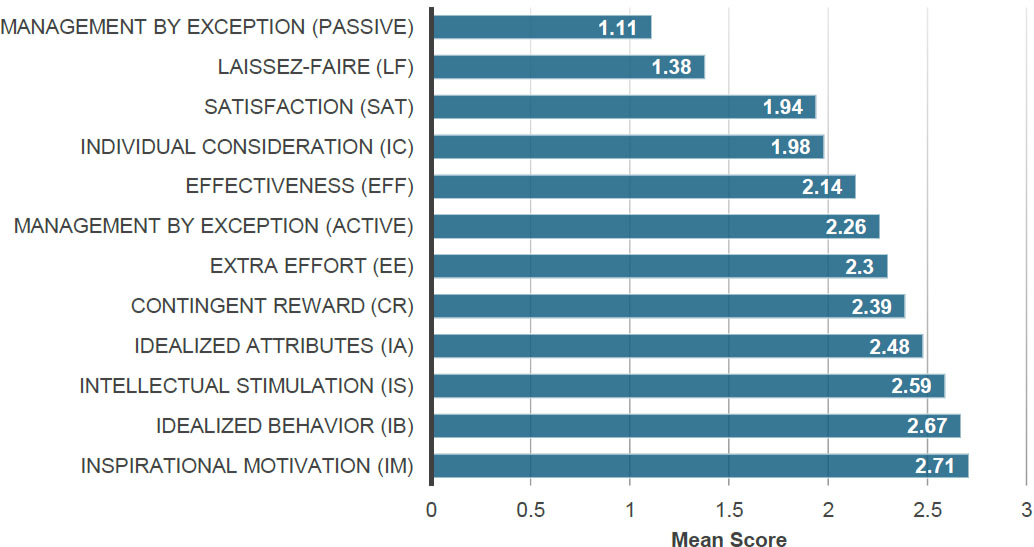
Mean scores of leadership subscales as perceived by nurses using the Multifactor Leadership Questionnaire (MLQ).
3.3. Extent of Registered Nurses’ Intent to Stay
The level of nurses’ intent to stay was assessed using McCain’s Behavioral Commitment Scale. The overall mean score was 3.74 (SD = 0.61), indicating a moderate to high level of commitment among participants to remain in their current positions. The highest-rated item was “I will probably spend the rest of my career in this job or the jobs that it leads to in this hospital” (M = 4.48, SD = 0.50), followed by “Even if this job does not meet all my expectations, I will not quit” (M = 4.34, SD = 0.47), and “I plan to work at my present job for as long as possible” (M = 3.75, SD = 0.89). In contrast, lower mean scores were observed for “Under no circumstances would I leave my present job” (M = 3.60, SD = 1.25) and “I plan to keep this job for at least two or three years” (M = 2.54, SD = 1.24), indicating that although nurses expressed strong long-term commitment to their roles, their confidence in remaining over the short term was comparatively weaker.
3.4. Correlation between Leadership Styles, Demographics, and Intent to Stay
The results showed strong, positive correlations between intent to stay and several transformational leadership subscales, including Inspirational Motivation (r = .83, p < .001), Individual Consideration (r = .79, p < .001), and Intellectual Stimulation (r = .46, p < .001). Smaller yet significant correlations were also observed with Idealized Attributes (r = .23, p = .001) and Idealized Behaviors (r = .22, p = .001).
Additional positive associations were found with Contingent Reward (r = .50, p < .001), Management by Exception (Active) (r = .20, p = .002), Effectiveness (r = .17, p = .009), and Satisfaction with Leadership (r = .34, p < .001). However, Extra Effort was not significantly correlated with intent to stay (r = .07, p = .304).
In contrast, passive leadership styles showed significant negative correlations: Management by Exception (Passive) (r = –.36, p < .001) and Laissez-Faire (r = –.17, p = .014). Department capacity was also negatively associated with intent to stay (r = –.14, p = .037). No significant correlations were found with age (r = –.06, p = .358) or years of experience (r = .07, p = .324) (Table 2).
| Variable | r | p-value |
|---|---|---|
| Transformational Leadership Style (TFL) | ||
| Inspirational Motivation | .826 | < .001 |
| Individual Consideration | .787 | < .001 |
| Intellectual Stimulation | .460 | < .001 |
| Idealized Attributes | .232 | .001 |
| Idealized Behaviors | .220 | .001 |
| Transactional Leadership Style (TAL) | ||
| Contingent Reward | .501 | < .001 |
| Management by Exception (Active) | .203 | .002 |
| Effectiveness | .175 | .009 |
| Satisfaction with Leadership | .344 | < .001 |
| Extra Effort | .070 | .304 |
| Passive Avoidant Leadership Style (PAL) | ||
| Management by Exception (Passive) | –.362 | < .001 |
| Laissez-Faire | –.166 | .014 |
| Age | –.062 | .358 |
| Years of Experience | .067 | .324 |
| Department Capacity | –.141 | .037 |
3.5. Differences in Intent to Stay based on Demographic Variables
Independent sample t-tests were conducted to examine differences in intent to stay based on categorical variables with two levels, including gender, department area, and educational level. The analysis revealed a statistically significant difference based on gender, with male nurses (M = 2.21) reporting a higher intent to stay compared to female nurses (M = 2.11), t(398) = 4.159, p < .001. No significant differences were found based on department area (t = 1.585, p = .115) or educational level (t = 1.190, p = .235) (Table 3).
| Variable | Category | M (SD) | t | p-value |
|---|---|---|---|---|
| Gender | Male Female |
2.21 (0.12) 2.11 (0.20) |
4.159 | < .001** |
| Educational Degree | BSN | 2.17 (0.16) | 1.190 | .235 |
| MSN | 2.14 (0.19) | |||
| Department Area | Medical/Surgical | 3.70 (0.60) | 1.585 | .115 |
| Critical Care | 3.84 (0.61) |
One-way ANOVA was used to explore differences in intent to stay based on variables with more than two categories, specifically financial status and marital status. A significant difference was observed based on financial status, F(2, 397) = 11.802, p < .001. Post hoc comparisons using the LSD test revealed that nurses earning between 500–1000 JOD reported significantly higher intent to stay (M = 3.85) than those earning less than 500 JOD (M = 3.40, p < .001). No statistically significant differences were found between nurses earning more than 1000 JOD and the other income groups. Marital status did not show a significant effect on intent to stay (p = .373) (Table 4).
| Variable | Category | M (SD) | F | p-value |
|---|---|---|---|---|
| Financial Status | < 500 JOD | 3.40 (0.61) | ||
| 500–1000 JOD | 3.85 (0.67) | 11.802 | < .001** | |
| > 1000 JOD | 3.50 (0.10) | |||
| Marital Status | Single | 3.80 (0.65) | ||
| Married | 3.72 (0.59) | 1.047 | .373 | |
| Divorced | 4.00 (0.65) | |||
| Widowed | 3.30 (0.14) |
4. DISCUSSION
This study was conducted to determine the relationship between nursing managers' leadership style and registered nurses’ intent to stay in Jordanian private hospitals. It also explored the influence of selected demographic and work-related factors on nurses’ intent to stay in their current positions. Retaining skilled nurses is a critical challenge for healthcare systems worldwide, especially among ongoing workforce shortages. This study's findings demonstrate a moderate to high intent to stay among registered nurses in Jordanian private hospitals; these findings suggest that improvements in workplace conditions, potentially including leadership approaches and supportive environments, may be enhancing nurse retention. Identifying the factors that influence nurses’ decisions to stay is vital for reducing turnover, ensuring continuity of care, and maintaining organizational stability.
The findings of this study identified transformational leadership as the predominant leadership style perceived among nurse managers, supporting previous research that highlights its prevalence and effectiveness [17-19]. Transformational leaders who clearly articulate vision and foster a collaborative team environment significantly contribute to increased job satisfaction and employee loyalty [20]. Notably, a strong positive correlation emerged between transformational leadership and nurses’ intent to stay. Within its dimensions, Inspirational Motivation and Individual Consideration exhibited particularly strong relationships with retention intentions, emphasizing the critical role of leaders who both inspire a shared purpose and provide personalized support. These findings align with prior studies suggesting that transformational leadership promotes a sense of belonging, opportunities for professional growth, and trust, factors essential to enhancing nurses’ long-term commitment to their organizations [13].
Transformational leadership encourages nurses’ self-worth, autonomy, and professional development, which are essential for creating a positive work environment. This leadership style has also been shown to promote evidence-based practice and improve patient outcomes, further strengthening nurses' commitment to their organizations [21, 22]. Transactional leadership, while less prominent, was also positively associated with nurses’ intent to stay. This style, which emphasizes clear expectations, structured roles, and contingent rewards, can contribute to stability and fairness in the workplace, thereby enhancing job satisfaction.
In contrast, passive leadership styles, particularly laissez-faire and management by exception (passive), were perceived less frequently and were negatively associated with nurses’ intent to stay. These findings are consistent with previous research indicating that passive leadership is associated with adverse effects on team performance and employee attitudes; when leaders are disengaged or avoid responsibility, it can increase stress, reduce motivation, and ultimately drive nurses to consider leaving their jobs [23-25]. This highlights the importance of cultivating proactive and supportive leadership behaviors within healthcare settings.
This study found that demographic characteristics had a limited impact on nurses’ intent to stay. Educational level and marital status showed no significant differences, consistent with previous research by AbuAlRub et al. [26]. However, gender was a significant factor, with male nurses reporting a higher intent to stay than females. This contrasts with earlier studies [27]. Furthermore, may reflect sociocultural influences such as increased family and caregiving responsibilities typically borne by women, especially during the COVID-19 pandemic [28].
Regarding work-related factors, nurses’ departmental placement did not significantly affect their intent to stay, which aligns with findings from a prior study [29]. In contrast, perceived financial adequacy showed a strong positive association with retention intentions. Nurses who considered their salaries fair or sufficient were more likely to remain in their current roles. This finding supports previous research highlighting the critical role of fair compensation in enhancing job satisfaction and fostering a sense of being valued, which promotes retention [14, 18]. Overall, demographic factors generally had a limited effect on nurses' retention, while workplace-related factors, particularly financial recognition, played a more substantial role in influencing nurses’ decisions to stay [30].
The findings of this study highlight the importance of focusing on workplace conditions, leadership style, and perceived organizational support when designing retention interventions. The positive association between transformational leadership and intent to stay highlights the need to promote effective leadership practices. Healthcare organizations should prioritize leadership development initiatives that enhance transformational and transactional leadership competencies among nurse managers. Training programs that focus on communication, motivation, and individualized staff support can help foster a positive work culture that encourages retention. Meanwhile, the negative impact of passive leadership underscores the importance of proactive managerial engagement. Leadership development programs and structured performance feedback mechanisms may help mitigate disengaged leadership behaviors.
Ensuring adequate and equitable compensation is essential to improving nurse retention. Institutions should provide competitive salaries and recognize nurses’ contributions to foster a sense of value and commitment. Staffing capacity must also be addressed, as excessive workload and inadequate resources may undermine retention efforts. Healthcare organizations should prioritize appropriate nurse-to-patient ratios and supportive scheduling practices. Additionally, gender-responsive strategies such as flexible work arrangements and enhanced support for work-life balance are vital to mitigate disparities and retain female nurses. These targeted interventions can collectively foster a more sustainable and committed nursing workforce.
5. LIMITATION
This study has several limitations. First, it included only nurses employed in private hospitals, and participants were selected through convenience sampling in a cross-sectional design. Consequently, the findings may not be representative of all nurses in Jordan. Future studies should employ longitudinal research designs and include nurses from all healthcare sectors, including public, private, and military hospitals, to improve the external validity of the findings.
In addition, examining other factors that influence nurse retention and incorporating qualitative research methods could provide a more comprehensive understanding of the issue. Finally, future research should evaluate interventions specifically designed to improve leadership practices, financial adequacy, and workload management to determine their effectiveness in promoting nurse retention.
CONCLUSION
In conclusion, this study highlights the critical role of leadership in promoting nurses’ intention to stay within healthcare organizations. Transformational leadership, the most frequently perceived leadership style, was positively associated with retention, while passive leadership was linked to lower intention to stay. In addition, perceptions of financial adequacy and department capacity were significant determinants of retention, emphasizing the importance of fair compensation and adequate staffing. These findings suggest that strengthening transformational leadership competencies, improving workplace resources, and ensuring supportive work environments may enhance nurse retention, workforce stability, and the quality of patient care. Demographic characteristics had little influence, indicating that organizational factors play a more substantial role in nurses’ decisions to remain in their positions.
AUTHORS’ CONTRIBUTIONS
The authors confirm their contributions to the paper as follows: W.A., G.Al.D: Study conception and design; W.A.: Data collection; W.A., H.K., G.Al.D.: Analysis and interpretation of results; W.A., H.K., G.Al.D.: Draft manuscript. All authors reviewed the results and approved the final version of the manuscript.
LIST OF ABBREVIATIONS
| TFL | = Transformational Leadership |
| TAL | = Transactional Leadership |
| PAL | = Passive Avoidant Leadership |
| MQL Form 5X | = Multifactor Leadership Questionnaire |
| ANOVA | = Analysis of Variance |
ETHICS APPROVAL AND CONSENT TO PARTICIPATE
The study was approved by the Institutional Review Board at the Applied Science Private University (IRB No. 2021-2022-2-8).
HUMAN AND ANIMAL RIGHTS
All procedures involving human participants were conducted in accordance with the ethical standards of the committee responsible for human experimentation (institutional and national), and with the Helsinki Declaration of 1975, as revised in 2013.
AVAILABILITY OF DATA AND MATERIALS
All the data and supporting material is available within the article.
ACKNOWLEDGEMENTS
The authors would like to express gratitude to the participants in this study who generously devoted their time and were essential to the data collection process. Additionally, the authors would like to acknowledge Applied Science Private University for its support of this study.